Yell51x-Ouz4 Model Explained
The Yell51x-Ouz4 model has gained traction as a data processing and analytics platform built for scale. It combines prediction engines, self-governing reaction systems, and cloud-ready expansion into a single package. Organizations across healthcare, finance, and manufacturing have adopted it in 2026 to handle growing data volumes. This is a closer look at how Yell51x-Ouz4 works and where it fits.
How the Yell51x-Ouz4 Model Architecture Works
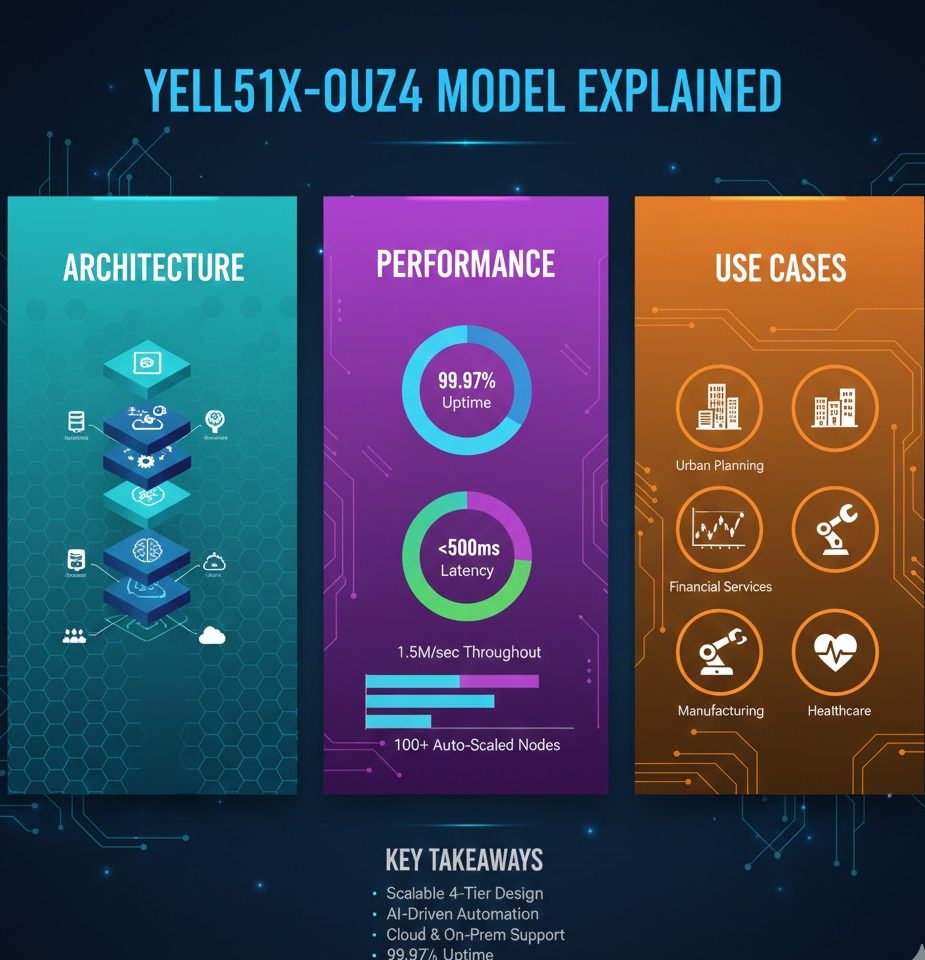
Yell51x-Ouz4 runs on a four-tier structure. Each tier handles a separate function, and together they allow the system to scale without performance loss. The architecture distributes workloads across layers, preventing bottlenecks during high-traffic periods.
| Tier | Purpose | Tools & Protocols |
|---|---|---|
| Input Handling | Pulls high-speed data from sensors, apps, and legacy platforms | Stream-based importers |
| Computation Engine | Runs instant calculations and data grouping | Apache Flink, Kafka Streams |
| AI Module | Spots patterns and drives automated decisions | TensorFlow, PyTorch support |
| Connectivity Layer | Links with outside apps and dashboards | REST APIs, WebSocket endpoints |
This layered setup gives Yell51x-Ouz4 both adaptability and room to expand as workloads shift. The input tier accepts structured and unstructured data simultaneously, feeding it into the computation engine for real-time processing. Organizations that depend on automated web data collection tools can integrate those feeds directly into the input tier.
Yell51x-Ouz4 Model Features and Capabilities
Several built-in capabilities separate the Yell51x-Ouz4 from older systems.
Simultaneous data operations let the model run multiple tasks at once, increasing output volume. Its self-adjusting intelligence reconfigures decision paths based on live metrics, keeping performance steady without manual tweaking.
Outlier identification catches unusual spikes or drops in data streams through statistical methods and trained models. Financial institutions have applied this function for fraud detection, where millisecond-level anomaly recognition matters. Automated health checks keep engineers informed about delays, slowdowns, or system strain through real-time dashboards.
The AI module supports both labeled and unlabeled training data. Teams can feed proprietary datasets into the system and receive model outputs within their existing pipelines. This flexibility has made Yell51x-Ouz4 popular among firms that already use platforms reviewed on sites like Increditools for comparing data tools.
Setting Up and Deploying Yell51x-Ouz4
Getting Yell51x-Ouz4 operational is straightforward on cloud platforms like AWS, Azure, or Google Cloud. Docker containers and Kubernetes handle orchestration, reducing launch times and enabling on-demand scaling.
For companies with established infrastructure, Yell51x-Ouz4 supports mixed deployment. Its API-first design means teams can plug it into current systems without replacing anything. Python, Java, C++, and JavaScript all connect through the API layer, so development teams can work in their preferred language.
On-premise installations are also supported, though cloud hosting remains the preferred option for easier scaling. Companies evaluating deployment strategies often reference resources for smarter business decision-making to weigh on-premise versus cloud tradeoffs.
Yell51x-Ouz4 Performance and Reliability Benchmarks
Recent benchmark tests produced clear performance data. The model processed 1.5 million events per second with latency under 500 milliseconds. System uptime reached 99.97% across a full year. Node expansion handled 100+ nodes with no manual setup required.
These numbers confirm that Yell51x-Ouz4 handles heavy, sustained loads. The sub-500ms latency figure is notable for applications where delayed processing carries financial or safety consequences. Businesses tracking technology adoption strategies have flagged these benchmarks as competitive with established platforms from larger vendors.
Yell51x-Ouz4 Use Cases Across Industries
The model works across a range of sectors. Each industry applies the system differently based on data type and processing requirements.
Urban Planning
Powers live traffic monitoring and environmental tracking through IoT sensor networks in smart city projects.
Financial Services
Detects fraud patterns and analyzes high-frequency trading data. Processes millions of transactions per second.
Manufacturing
Drives predictive maintenance and automated quality control on factory floors using sensor data feeds.
Healthcare
Centralizes patient data streams and applies pattern recognition for early diagnostic alerts.
In finance, Yell51x-Ouz4’s anomaly detection has been applied to identify irregular trading sequences within milliseconds. Manufacturing operations use the predictive maintenance module to schedule repairs before equipment fails, reducing unplanned downtime. Similar to how platforms like Foxfiny.com apply data-driven methods in marketing, Yell51x-Ouz4 applies data-driven methods to operational decisions.
Yell51x-Ouz4 Model Licensing and Open-Source Components
The core Yell51x-Ouz4 model operates under a proprietary license. Some connectors, adapters, and integration modules are available freely on GitHub. This hybrid approach lets teams test compatibility before committing to full deployment.
The API documentation covers integration with existing systems across multiple programming languages. Companies running fintech applications, including those evaluated on crypto trading platforms, have used the open connectors to build custom data pipelines without modifying the core system.
FAQs
Is the Yell51x-Ouz4 model open-source?
The core model is proprietary. Some connectors and adapters are available as open-source on GitHub for integration testing and development.
Can teams train Yell51x-Ouz4 on custom datasets?
Yes. The AI module accepts both labeled and unlabeled training data across various formats and pipeline configurations.
Which programming languages work with Yell51x-Ouz4?
Python, Java, C++, and JavaScript connect through its API layer. SDKs are available for each language.
Does Yell51x-Ouz4 run on local servers?
It supports on-premise deployment. Cloud hosting on AWS, Azure, or Google Cloud remains the recommended option for scaling.
What happens during a system crash?
Built-in backup routines and failover protocols maintain operations during hardware or software failures with minimal data loss.