Is Anon Vaul Private Cloud Storage Safe
Online threats grow every year. Hackers, corporations, and government agencies access sensitive files without permission. Anon Vault addresses this by letting users save digital content without revealing their identity. This privacy-oriented platform locks every file on your device before uploading it. Not even the service itself can view your stored material.
Reporters, human rights workers, companies, and ordinary people rely on Anon Vault private cloud storage to guard documents, images, and conversations from unauthorized access.
How Does Anon Vault Keep Your Files Safe?
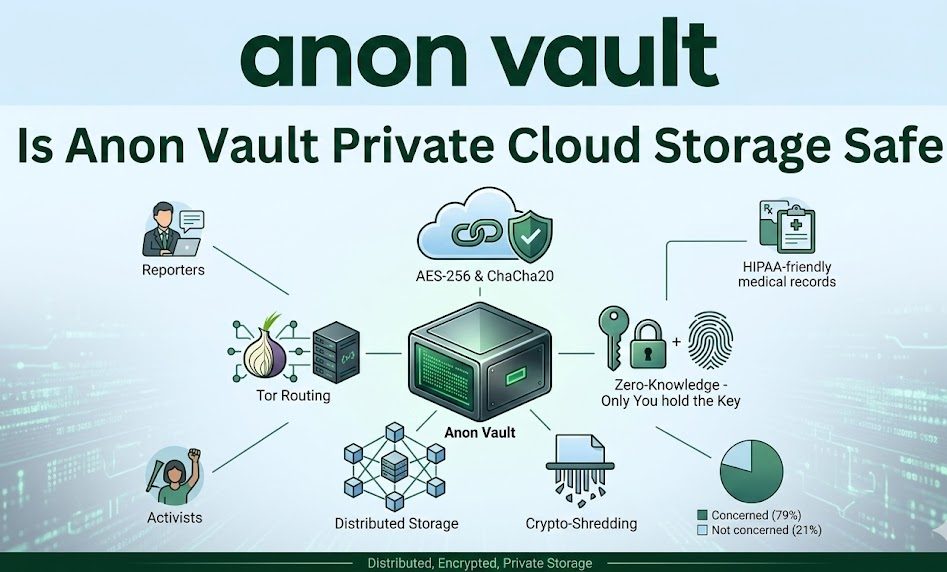
Anon Vault applies client-side encryption through AES-256 and ChaCha20 algorithms. Your content gets sealed before it reaches any server. Only you hold the decryption key.
The platform also strips away all activity records. It does not log upload times, file sizes, or access patterns. This zero-knowledge approach means Anon Vault has no record of what you store or when you access it.
If you want to learn about other tools shaping how we interact with technology, the breakdown of modern navigation systems on TTS Vibes covers real-time positioning and satellite routing.
Anon Vault Identity and Location Protection
Anon Vault supports routing through the Tor network. This masks your IP address and geographic location during uploads or downloads. The service also spreads files across multiple nodes rather than one central server. This distributed setup reduces the chance of a single breach exposing your data.
For permanent deletion, Anon Vault offers crypto-shredding. It destroys the decryption key tied to your files. Even if fragments remain on a server, nobody can read them again.
Anon Vault Compared With Other Cloud Storage Platforms
| Capability | Anon Vault | Dropbox | Proton Drive |
|---|---|---|---|
| Full Encryption (AES-256 / ChaCha20) | Yes | Partial | Yes (AES-256) |
| Zero-Knowledge Activity Logs | Yes | No | No |
| Tor Routing Support | Yes | No | No |
| Crypto-Shredding | Yes | No | No |
| Sign-Up Without ID | Yes | No | Yes |
Who Can Benefit from Anon Vault Private Cloud Storage?
Journalists protecting sources in hostile regions turn to Anon Vault regularly. Medical providers share HIPAA-friendly records through its encrypted channels. Activists communicating under censorship rely on its hidden pathways to stay connected.
Businesses guard trade secrets and client records with granular access controls. Regular users simply want a private space for personal media, documents, and financial records without third-party surveillance.
For readers interested in safeguarding their broader digital presence, the TheHomeTrotters.com review on TTS Vibes covers smart home security and connected device recommendations.
Upcoming Developments for Anon Vault
The team behind Anon Vault plans to add blockchain-backed verification for tamper-proof storage. Upgraded encryption methods will make unauthorized access harder. A business plugin launching in 2025 aims to connect the platform with corporate workflows. Interface updates will simplify the experience for first-time users.
Those curious about blockchain-related tools can also read how Crypings.com tracks digital currency on TTS Vibes.
Possible Drawbacks of Anon Vault Anonymous Storage
Heavy encryption and Tor routing can slow upload and download speeds. Weak internet connections may worsen this lag. If you lose your decryption key, there is no recovery option. That total privacy cuts both ways.
The anonymity Anon Vault provides also carries ethical weight. While it protects lawful privacy, bad actors could misuse such secrecy. Users should always operate within legal boundaries.
A 2021 Pew Research Center study found that 79% of American adults worry about corporate use of their personal data. Platforms built around anonymity like Anon Vault respond directly to that concern. The YourAssistantLive.com guide on TTS Vibes offers a look at how AI-powered tools handle user data differently.
Is Anon Vault Private Cloud Storage Safe to Use?
Anon Vault uses AES-256 encryption, the same standard applied by government agencies for classified material. Combined with zero-knowledge architecture, Tor routing, and distributed storage, the platform removes most attack surfaces common in traditional cloud services.
No system is 100% breach-proof. But Anon Vault’s design means that even a compromised server yields only unreadable encrypted fragments. Without the user’s private key, the data stays locked.
Secure file storage also depends on user behavior. Keeping your private key safe, using strong passphrases, and setting file expiration dates all strengthen your overall protection. The Etherions Faston Crypto overview on TTS Vibes explains how blockchain consensus models add another verification layer to digital assets.
Final Thoughts
Anon Vault gives users a strong option for storing files without sacrificing anonymity. Its encryption standards, distributed architecture, and permanent deletion features separate it from mainstream alternatives. As digital privacy concerns keep rising, tools like Anon Vault will continue to attract users who want full control over their own data.
For more on how digital platforms handle productivity and data management, the Blog WizzyDigital.org review on TTS Vibes covers practical strategies for working smarter online.
FAQs
Is Anon Vault free to use?
Some versions of Anon Vault are free. Premium plans offer more storage capacity and longer file retention periods. Pricing varies by provider.
Can I recover files if I lose my Anon Vault decryption key?
No. Anon Vault uses zero-knowledge encryption, so no recovery option exists. Store your private key in a separate, secure location.
Does Anon Vault work on mobile devices?
Yes. Anon Vault runs on web browsers across mobile and desktop. Some versions also offer dedicated iOS and Android apps.
Is Anon Vault legal to use?
Yes. Using encrypted cloud storage is legal in most countries. Users are responsible for ensuring their stored content complies with local laws.
How does Anon Vault compare to Proton Drive for private cloud storage?
Both use AES-256 encryption. Anon Vault adds Tor routing, crypto-shredding, and requires no personal information at sign-up. Proton Drive logs some activity metadata.