Growth Navigate Funding For Expanding Your Startup
Every new business needs money to grow. But raising capital without a plan often leads to trouble. Growth navigate funding is the approach that helps founders secure the right capital at the right stage, spend it on measurable outcomes, and build trust with investors over time. In 2026, with competition rising and backers demanding better metrics, this approach matters more than ever.
What Is Growth Navigate Funding for Startups?
Growth navigate funding is the process of identifying, securing, and deploying capital in a way that aligns with a company’s growth stage and operational targets. It is not about collecting the largest check possible. It is about choosing the right source, timing, and amount to move the business forward without losing ownership or control.
Investors in 2026 apply the Rule of 40 — where a company’s revenue growth rate plus profit margin must exceed 40% — even to early-stage evaluations. That means founders need a credible path to positive unit economics, not just high growth rates.
How Does Growth Navigate Funding Work?
The approach focuses on three things: securing capital at the correct moment, selecting backers who match your goals, and tying every dollar to a measurable result. Each funding round should act as a bridge between growth phases, not a finish line.
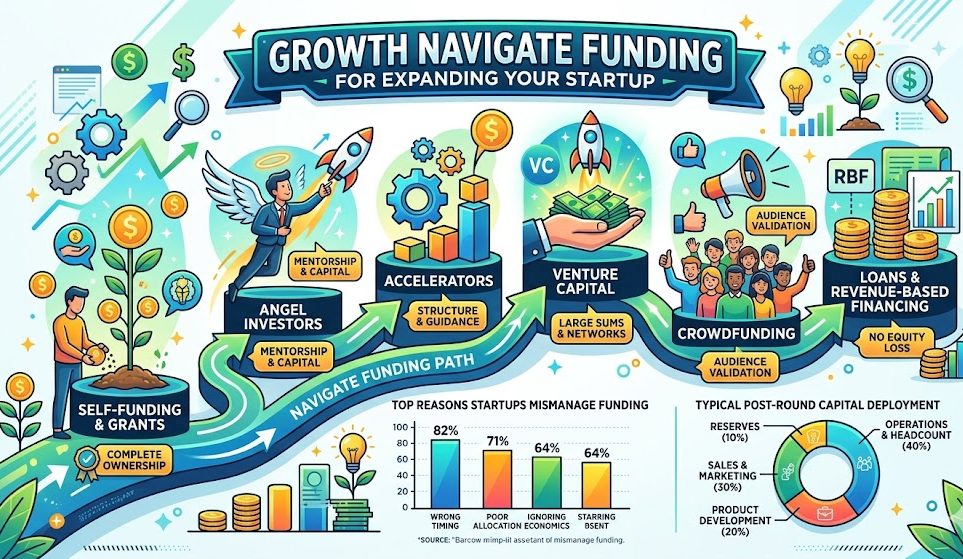
Below is a breakdown of the main capital sources startups use today and what each one offers.
| Capital Source | Best Suited For | Key Advantage |
|---|---|---|
| Self-funding | Very early ideas | Complete ownership |
| Angel investors | Pre-revenue startups | Mentorship and capital combined |
| Venture capital | Fast-scaling companies | Large sums plus networks |
| Loans and credit | Revenue-positive firms | No equity loss |
| Crowdfunding | Consumer-facing products | Audience validation |
| Accelerator programs | Startups needing structure | Seed cash plus guidance |
Revenue-based financing (RBF) has also gained traction for software companies. RBF works well when a company has predictable recurring revenue and wants to preserve equity. Venture capital suits companies pursuing aggressive market capture where speed matters more than short-term margins.
Why Founders Struggle Without a Growth Navigate Funding Strategy
Many startups fail not because their product is weak but because they mishandle capital. Common traps include raising too soon (which dilutes ownership), waiting too long (which forces bad deals), and accepting money that does not match their timeline.
Chasing high valuations instead of smart partnerships is another common error. Growth navigate funding teaches founders to match the capital type to the business model, not to what sounds most prestigious. Using purpose-built digital tools for managing operations and financial tracking helps founders stay on top of burn rate and unit economics throughout each phase.
Matching Your Startup Phase to the Right Capital Route
Each business phase demands different metrics and a different capital approach. Early on, user feedback and demand validation matter most. Later, retention rates, customer acquisition costs, and monthly recurring revenue take priority.
| Business Phase | Primary Goal | Typical Capital Route |
|---|---|---|
| Concept testing | Prove demand exists | Personal savings, grants |
| Post-product-market fit | Grow revenue and users | Seed rounds, accelerators |
| Rapid expansion | Enter new markets | Series A/B/C, private equity |
Seed investors typically take 10–20% equity. Series A investors take 15–25%. Later rounds vary based on valuation and capital requirements. Founders should start fundraising conversations 9–12 months before capital needs become urgent, which allows enough time for relationship building and negotiation.
How to Prepare Before You Pitch Investors for Growth Funding
Investors in 2026 expect clean financials. Before any meeting, prepare 18–24 months of projected expenses, a breakdown of unit economics, and a clear explanation of how the capital will be used.
A strong pitch for growth navigate funding covers five areas: the problem, your solution, the market size, your revenue model, and proof of early results. Founders who refine this pitch repeatedly tend to close rounds faster — early rejections often mean the story needs clarity, not that the idea is wrong.
Seed-stage AI startups recorded valuation premiums of roughly 42% compared to non-AI peers at the same stage in 2025, according to PitchBook data. Regardless of sector, demonstrating a clear path to profitability now carries more weight than headline growth numbers alone.
Common Startup Capital Allocation Mistakes to Avoid
Spending before documenting workflows, ignoring unit economics until they become urgent, and pitching without data-backed go-to-market plans are among the most common errors. Others overfund early, accepting venture capital when revenue-based financing would have preserved more equity. Proper capital allocation — around 40% to operations, 30% to sales and marketing, 20% to product development, and 10% held in reserves — keeps burn rate predictable and investors confident. Running targeted ad campaigns with real-time spend tracking helps founders stay accountable on the marketing side of that allocation.
What Comes After Closing a Growth Navigate Funding Round
Post-raise discipline separates companies that scale from those that stall. Track burn rate, monthly recurring revenue, and gross margin weekly. Report regularly to investors — this builds the trust that makes follow-on rounds easier to close.
Protect company culture as headcount rises. Spend on operations that directly drive revenue. Each dollar should connect to a result. The goal is not to spend the round — it is to reach the next milestone with enough runway to negotiate from strength.
FAQs
What is growth navigate funding?
Growth navigate funding is the strategic process of identifying, securing, and deploying capital aligned with a company’s growth stage and operational goals. It prioritizes the right source and timing over the largest check available.
When should a startup start raising funding?
Begin fundraising conversations 9–12 months before capital becomes urgent. This allows time to build investor relationships, negotiate favorable terms, and avoid accepting bad deals under pressure.
What metrics do investors look at for growth navigate funding?
Investors evaluate revenue growth rate, customer acquisition cost, lifetime value ratio, monthly recurring revenue, and gross margin. Many now apply the Rule of 40 even at the seed stage.
Can startups raise capital without giving up equity?
Yes. Revenue-based financing, business loans, government grants, and strategic partnerships provide capital without significant equity dilution. The right option depends on revenue predictability and growth stage.
What are the biggest capital allocation mistakes startups make?
Overfunding too early, accepting misaligned investors, ignoring cash reserves after closing, and spending on features before locking in a go-to-market plan are the most common errors founders make.