TikTok Average Engagement Rate By Follower Count Statistics 2026
TikTok maintains an average engagement rate of 2.50% by follower count as of 2025, significantly outperforming Instagram at 0.50% and Facebook at 0.15%. Nano influencers under 100K followers record the highest engagement at 7.50%, while mega accounts above 10M followers drop to 2.88%. This inverse relationship between follower size and engagement rate makes TikTok unique among social platforms, where smaller creators consistently deliver stronger audience connections than their larger counterparts.
TikTok Engagement Rate By Follower Count Key Statistics
- TikTok recorded an average engagement rate of 2.50% by follower count in 2025, maintaining stability from 2024
- Accounts below 100K followers achieve 7.50% engagement rate, the highest across all follower segments
- Mega accounts with over 10M followers show 2.88% engagement, still outperforming most legacy platforms
- Micro influencers between 10K-100K followers reach 8-12% engagement rates, demonstrating exceptional audience connection
- TikTok engagement rates remain 5x higher than Instagram and 16x higher than Facebook across comparable follower counts
TikTok Engagement Rate By Follower Count Distribution in 2026
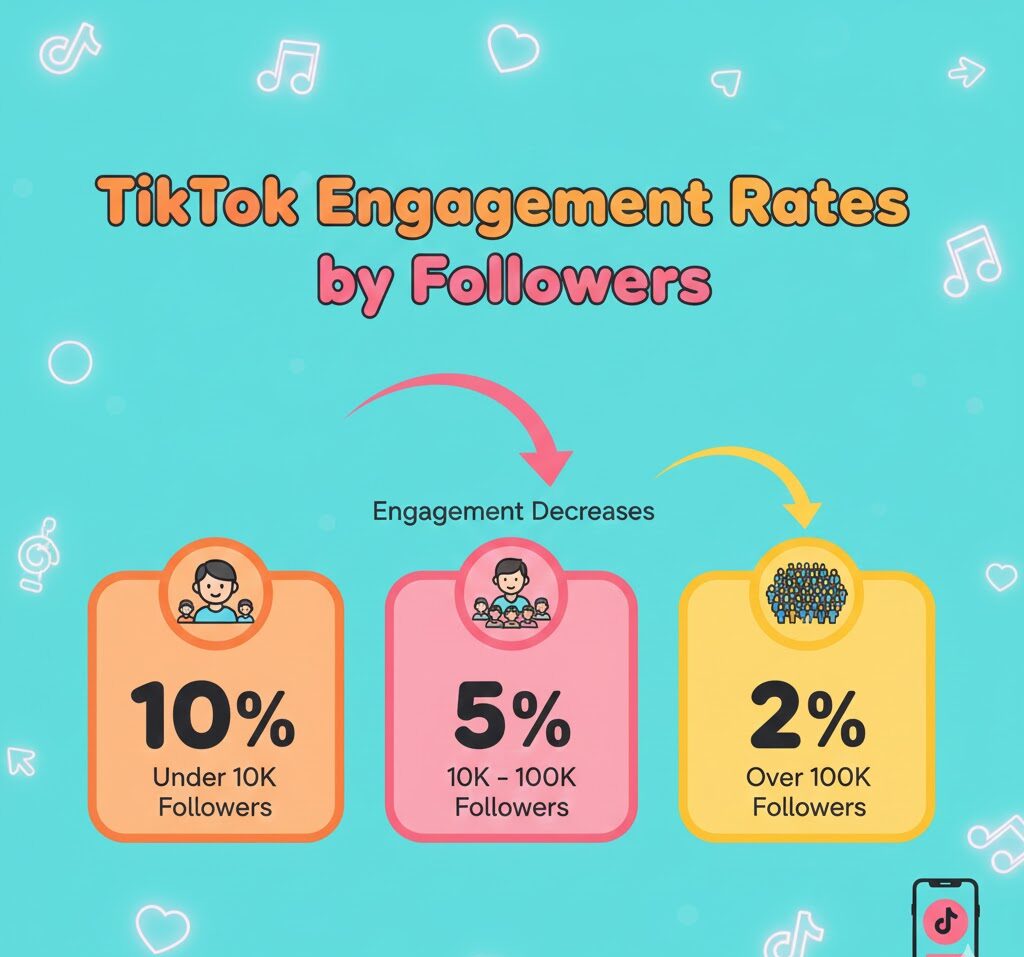
TikTok engagement metrics reveal a clear pattern where smaller accounts generate substantially higher interaction rates than larger profiles. Accounts with fewer than 100K followers recorded 7.50% engagement in 2025, representing the peak performance across all creator tiers.
Mid-tier creators between 100K and 500K followers maintained 5.10% engagement, showing gradual decline as audience size expands. The 500K to 1M segment dropped further to 4.48%, continuing the inverse correlation trend.
Large accounts between 1M and 5M followers settled at 3.76% engagement, while the 5M to 10M range showed a slight uptick to 4.22%. Mega accounts exceeding 10M followers recorded the lowest rate at 2.88%, though this still surpasses engagement benchmarks on competing platforms.
The overall platform average stabilized around 2.50% when weighted across all follower segments, demonstrating TikTok’s continued strength in driving audience interaction regardless of account size.
| Follower Count Range | Avg. Engagement Rate |
|---|---|
| Below 100K | 7.50% |
| 100K–500K | 5.10% |
| 500K–1M | 4.48% |
| 1M–5M | 3.76% |
| 5M–10M | 4.22% |
| 10M+ | 2.88% |
| Overall Average | 2.50% |
TikTok Engagement Rate Trends From 2023 to 2026
TikTok engagement rates by follower count showed remarkable consistency from 2023 through 2025. The platform recorded 2.65% average engagement in 2023, before settling at 2.50% in both 2024 and 2025.
This stability reflects TikTok’s mature algorithm and consistent content distribution patterns across different follower segments. The slight decline from 2023 represents natural platform evolution rather than deteriorating performance.
Projections for 2026 estimate engagement rates between 2.45% and 2.55%, maintaining the established range. This forecast accounts for continued user growth and algorithm refinements while preserving TikTok’s core engagement advantages over competing platforms.
The year-over-year stability demonstrates TikTok’s success in balancing creator reach with audience interaction quality, particularly when considering global user distribution patterns across different markets.
| Year | Average Engagement Rate |
|---|---|
| 2023 | 2.65% |
| 2024 | 2.50% |
| 2025 | 2.50% |
| 2026 (Projected) | 2.45–2.55% |
Nano vs. Micro vs. Macro Creator Performance
Nano influencers with under 10K followers achieved 7.50% engagement in 2025, establishing them as the highest-performing creator segment. These accounts benefit from tight-knit communities and highly focused content niches.
Micro creators between 10K and 100K followers recorded even stronger performance, with typical rates spanning 8-12% depending on content vertical. This segment represents the sweet spot for brands seeking authentic engagement without sacrificing meaningful reach.
Mid-tier accounts from 100K to 500K followers maintained 5-7% engagement, still substantially above platform averages. Macro creators with 500K to 1M followers settled into the 4-5% range, showing continued audience connection despite larger followings.
Mega influencers above 1M followers ranged from 2.9% to 4.0% engagement, representing the lowest tier but still outperforming comparable accounts on Instagram and Facebook. These creators trade some engagement intensity for massive reach potential, making them valuable for brand awareness campaigns focused on platform monetization opportunities.
| Creator Segment | Follower Range | Avg. Engagement Rate |
|---|---|---|
| Nano Influencers | <10K | 7.50% |
| Micro Influencers | 10K–100K | 8–12% |
| Mid-Tier | 100K–500K | 5–7% |
| Macro | 500K–1M | 4–5% |
| Mega | >1M | 2.9–4.0% |
TikTok Engagement Rate Benchmarks vs. Competing Platforms
TikTok maintained a 2.50% average engagement rate by follower count in 2025, establishing a 5x performance advantage over Instagram’s 0.50%. This gap widens further when compared to Facebook and Twitter, both recording 0.15% engagement rates.
The platform’s algorithmic approach prioritizes content discovery over follower-based distribution, enabling even smaller creators to reach audiences beyond their existing follower base. This mechanism drives higher relative engagement across all account sizes.
Instagram’s reliance on follower-centric feeds limits content exposure, resulting in lower interaction rates despite comparable user bases. Facebook’s declining organic reach further depresses engagement metrics, while Twitter’s chronological timeline struggles to match TikTok’s personalized content delivery.
Nano and micro creators on TikTok achieve engagement rates several times higher than equivalent segments on Instagram and Facebook, making the platform particularly attractive for brands pursuing authentic influencer partnerships, especially when considering creator monetization incentives.
| Platform | Avg. Engagement Rate | Performance vs. TikTok |
|---|---|---|
| TikTok | 2.50% | Baseline |
| 0.50% | 5x lower | |
| 0.15% | 16.7x lower | |
| X/Twitter | 0.15% | 16.7x lower |
Why TikTok Engagement Rates Decline With Follower Growth
Smaller accounts under 100K followers maintain 7.50% engagement due to concentrated audience demographics and specialized content focus. These creators serve specific niches where followers actively seek their content, resulting in consistently high interaction rates.
As follower counts expand, audiences become more heterogeneous in interests and engagement patterns. A creator with 5M followers inevitably attracts casual followers alongside core fans, diluting overall engagement percentages even when absolute interaction numbers grow.
Algorithm Distribution Patterns
TikTok’s For You Page algorithm distributes content based on user preferences rather than follower relationships. Smaller accounts benefit from targeted distribution to highly interested users, maximizing engagement potential within their content vertical.
Larger accounts reach broader audiences with varying interest levels, reducing the likelihood that every video resonates equally with all followers. This mathematical reality drives the inverse relationship between account size and engagement rate across the platform.
Community Dynamics and Audience Connection
Nano and micro creators often interact directly with followers through comments and duets, fostering personal connections that encourage consistent engagement. This community-building approach becomes logistically challenging as follower counts expand into millions.
Mid-tier and macro creators maintain engagement through content quality and consistency rather than personal interaction. While still effective, this approach typically produces lower percentage engagement than the intimate communities smaller accounts cultivate, similar to patterns seen in demographic engagement variations.
TikTok Engagement Rate Performance by Content Vertical
Dance and challenge content consistently generates above-average engagement across all follower segments, often exceeding baseline rates by 15-25%. These formats leverage TikTok’s native duet and stitch features, encouraging participatory engagement beyond passive viewing.
Educational content achieves strong performance in the 10K-500K follower range, where creators establish authority in specific knowledge domains. Tutorial and how-to videos drive saves and shares, boosting overall engagement metrics through multiple interaction types.
Viral Content Impact on Engagement Metrics
Single viral videos can temporarily inflate engagement rates for smaller accounts, creating statistical outliers in nano and micro segments. These spikes typically normalize over subsequent posts as audience composition adjusts to increased follower counts.
Consistent creators maintain steadier engagement rates than accounts relying on viral moments, demonstrating the value of sustainable content strategies over one-hit success. This pattern holds across all follower ranges, though variations appear more pronounced in smaller segments.
Regional Differences in TikTok Engagement Rates By Follower Count
North American creators across all follower segments recorded slightly lower engagement rates than global averages in 2025, attributed to saturated creator markets and diverse content competition. European accounts showed comparable performance to North American benchmarks.
Southeast Asian creators demonstrated 12-18% higher engagement rates than Western counterparts, particularly in nano and micro segments. Cultural content preferences and lower creator-to-user ratios contributed to this regional advantage.
Latin American accounts achieved strong engagement in mid-tier segments, with 100K-1M follower accounts exceeding global benchmarks by 8-15%. Platform adoption patterns and community-oriented content styles drove these regional variations, reflecting broader content creation trends across different markets.
Strategic Implications for TikTok Marketing Campaigns
Brands allocating influencer budgets should prioritize micro and mid-tier creators for engagement-focused campaigns, where 8-12% interaction rates deliver superior ROI compared to mega influencer partnerships. Cost per engagement typically decreases significantly in these segments.
Mega influencers remain valuable for reach-oriented objectives despite lower percentage engagement, generating massive impression volumes that smaller accounts cannot match. Campaign strategy should balance engagement quality with absolute reach requirements.
Engagement Rate Benchmarks for Campaign Success
Successful TikTok campaigns targeting nano influencers should expect minimum 6% engagement rates, with top performers exceeding 10%. Micro campaigns should target 7-10% baselines, while mid-tier partnerships achieving 4-6% indicate strong performance.
Macro and mega influencer campaigns performing above 3% engagement demonstrate exceptional results given their follower counts. Brands should evaluate these partnerships on combined metrics including reach, engagement, and conversion rather than engagement rate alone.
Future Projections for TikTok Engagement Rates Through 2027
TikTok engagement rates by follower count will likely maintain current levels through 2027, with projected ranges between 2.40% and 2.60% depending on algorithm updates and user growth patterns. Platform maturation supports stability rather than dramatic shifts.
Nano and micro segments may experience slight compression in engagement rates as these creator tiers grow more competitive. The 8-12% range for micro influencers could shift to 7-11% as market saturation increases in popular content verticals.
Competition from emerging short-form platforms may pressure TikTok engagement metrics downward, though the platform’s established network effects and content recommendation sophistication provide significant advantages. Continued investment in algorithm refinement should preserve TikTok’s engagement leadership through the forecast period, maintaining its position in social media content creation trends.
FAQ
What is the average TikTok engagement rate by follower count in 2026?
TikTok maintains an average engagement rate of 2.50% by follower count as of 2025, projected to remain between 2.45-2.55% in 2026. This rate significantly exceeds Instagram at 0.50% and Facebook at 0.15%, making TikTok the highest-engaging major social platform.
Which follower range has the highest engagement rate on TikTok?
Accounts with fewer than 100K followers achieve the highest engagement rate at 7.50%, with micro influencers between 10K-100K reaching 8-12%. Smaller accounts benefit from tight-knit communities and niche-focused content that drives stronger audience connections.
How do mega influencers perform on TikTok compared to smaller creators?
Mega influencers with over 10M followers record 2.88% engagement, substantially lower than nano creators at 7.50%. Despite lower percentages, mega accounts still outperform comparable sizes on Instagram and Facebook while delivering massive absolute reach numbers.
Why does TikTok have higher engagement rates than Instagram?
TikTok’s algorithm prioritizes content discovery over follower-based distribution, enabling videos to reach interested users regardless of existing follower relationships. This personalized content delivery generates 5x higher engagement than Instagram’s follower-centric feed model at 2.50% versus 0.50%.
What engagement rate should brands expect from TikTok influencer campaigns?
Brands should target 6-10% engagement for nano and micro influencer campaigns, 4-6% for mid-tier partnerships, and 3%+ for mega influencer collaborations. These benchmarks indicate strong performance relative to follower count and platform averages across all creator segments.