TikTok Original Sound vs Trending Sound Performance Statistics 2026
TikTok creators using trending sounds recorded a 47% reach increase in late 2025, while original audio initially showed 22% lower visibility. Sound selection now drives 88% of user engagement on the platform, with 73% of viewers stopping specifically for audio-enabled content. The algorithmic advantage of trending sounds operates within a one to three week window, creating strategic tension between immediate reach and long-term brand building.
TikTok Original Sound vs Trending Sound Key Statistics
- TikTok trending sounds increase content reach by 47% compared to videos without strategic audio selection as of 2025.
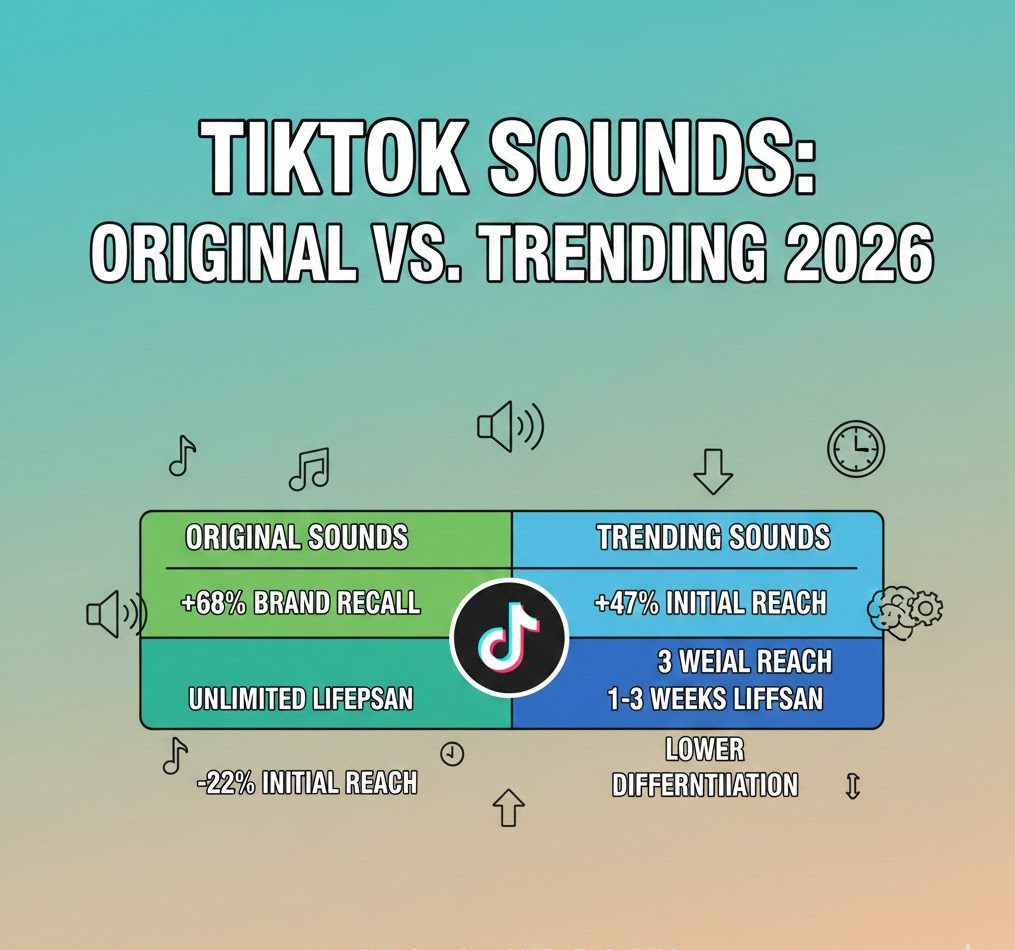
- Original sounds face 22% lower initial reach but offer unlimited lifespan potential when successfully executed.
- Trending audio delivers 66% higher engagement rates, though most sound trends last only one to three weeks before saturation.
- Users remember brands 68% better when content features distinctive audio they enjoy according to TikTok internal research.
- 84% of songs appearing on Billboard Global 200 in 2024 first gained traction through TikTok viral moments.
TikTok Sound Performance Overview
Audio functions as the primary discovery mechanism on TikTok. The platform reported that 88% of users consider sound essential to their experience, significantly higher than visual-first platforms.
Videos featuring trending sounds showed 66% higher engagement compared to content without strategic audio selection. The algorithm explicitly favors sound-based distribution, connecting users through shared audio behavior patterns.
Brand recall improved by 68% when content featured songs or sounds that users enjoyed. This metric demonstrates why audio strategy carries commercial weight beyond simple engagement numbers.
The platform’s 71% decision threshold at the three-second mark explains why audio hooks became non-negotiable for content performance. Creators must capture attention immediately, and trending sounds provide instant familiarity that reduces cognitive friction.
TikTok Trending Sound Performance Metrics
Trending sounds operate as algorithmic accelerators. Data from late 2025 indicated that content using trending audio increased reach by up to 47% compared to videos without strategic sound selection.
The algorithm connects users through shared audio behavior, surfacing content to audiences already engaging with that particular sound. This creates a network effect where established audio already has engagement signals the algorithm can leverage for distribution.
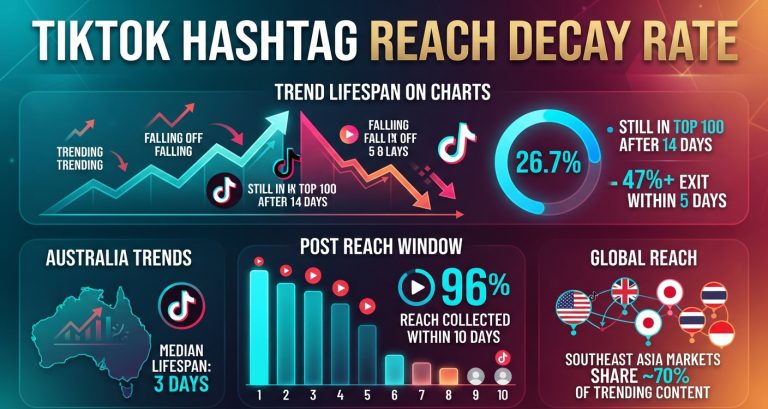
Most sound trends last only one to three weeks before engagement drops off. Some persist for months if they generate strong meme potential or cross into multiple content niches.
| Trend Phase | Duration | Engagement Level | Strategy |
|---|---|---|---|
| Early Adoption | Days 1-5 | Peak | Jump immediately for priority |
| Mass Adoption | Days 6-14 | High but competitive | Strong hook required |
| Saturation | Weeks 3-4 | Declining | Move to next trend |
| Extended Trends | 3-6 weeks average | Varies | Campaign attachment |
Early adoption during a sound’s rising phase delivers exponentially better results than late participation. Creators who utilized trending sounds within the first week of emergence captured the algorithm’s distribution boost before market saturation diminished returns.
Billboard chart analysis validated TikTok’s sound-to-success pipeline. In 2024, 84% of songs that appeared on the Billboard Global 200 first went viral on TikTok.
TikTok Original Sound Performance Analysis
Original sounds present a different performance profile. Data indicated that creators using original audio initially saw approximately 22% lower reach compared to users of trending sounds.
The algorithm prioritizes familiar audio patterns, creating an initial discovery disadvantage for novel sounds. However, original sounds unlock unique advantages unavailable through trending audio adoption.
Successful original sounds can be listed in recommended and trending categories, enabling other creators to use them. This generates compounding exposure over time that trending sound adoption cannot replicate.
The brand recall statistic proved particularly significant for business accounts. Users remembered brands 68% better when content featured songs or sounds they enjoyed.
Original sounds that successfully resonated generated stronger long-term brand association than repeatedly adopting trending audio. This advantage compounds over time as the original sound gains recognition.
Performance Factor Comparison
| Factor | Trending Sound | Original Sound |
|---|---|---|
| Initial Reach | +47% boost | -22% initially |
| Lifespan | 1-3 weeks average | Unlimited if successful |
| Differentiation | Low (shared audio) | High (unique identity) |
| Brand Recall | Moderate | +68% improvement |
| Content Reuse | Not applicable | Possible if gains traction |
TikTok Engagement Rates by Creator Size
Engagement rates on TikTok varied dramatically based on account size and content strategy. The platform maintained an average engagement rate of 2.5% by follower count, positioning it ahead of other major social platforms.
This baseline masked significant variation across creator tiers. Nano-influencers with 1,000 to 10,000 followers recorded engagement rates exceeding 10%, while mega-influencers with over 10 million followers showed 2.88% average engagement.
The inverse relationship between follower count and engagement rate had strategic implications for sound selection. Nano and micro-influencers who maintained the highest engagement rates often succeeded with original sounds that cultivated community-specific identity.
Larger accounts benefited more from trending sounds to maintain relevance with broader, less connected audiences. TikTok videos over 54 seconds achieved a 6.7% average engagement rate, suggesting longer-form content with original audio narratives could outperform quick trend participation when executed effectively.
Brand Strategy and Commercial Performance
For brands operating on TikTok, the decision between original sound versus trending audio carried significant commercial weight. Brand accounts recorded average engagement rates of 3% to 5% during 2024, notably higher than the 1% to 2% typical on competing platforms.
The Commercial Music Library provided brands access to over one million pre-cleared sounds. This created a competitive disadvantage as multiple brands used identical audio, diluting distinctiveness.
User preference data created tension with differentiation goals. 67% of users preferred brand content incorporating trending music, yet this approach risked sonic homogeneity in content strategy.
| Metric | Result |
|---|---|
| Brand Engagement on TikTok | 3-5% |
| Brand Engagement on Other Platforms | 1-2% |
| User Preference for Trending Music | 67% |
| 3-4 Week Campaign Awareness Boost | +24.5% |
| 5-6 Week Campaign Association Boost | +5.7% |
Campaign duration data provided additional guidance. Advertisers running campaigns for three to four weeks drove 24.5% higher awareness than average TikTok brand lift results.
Campaigns lasting five to six weeks achieved 5.7% higher brand association. This suggested sustained original sound strategies might outperform trend-chasing when committed to longer timelines.
Algorithm Sound Signals
The TikTok algorithm primarily categorizes content based on audio. Sounds function alongside hashtags and captions to determine content distribution.
Videos are surfaced to users who previously engaged with that audio. This creates a network effect for trending sounds where established audio already has engagement signals the algorithm can leverage for distribution.
Original sounds must build these signals from zero, explaining the initial reach deficit. The algorithm now employs advanced computer vision and speech recognition to understand video content contextually, even without explicit hashtags.
Original sounds with clear thematic identity may receive better categorization than generic trending audio misaligned with visual content. The algorithm rewards both approaches differently through existing engagement network amplification for trending sounds and authentic content categorization for original audio.
FAQs
Do trending sounds always perform better than original sounds on TikTok?
Trending sounds provide 47% higher initial reach and 66% engagement boost but last only one to three weeks. Original sounds show 22% lower initial reach but offer unlimited lifespan and 68% stronger brand recall when successful.
How long do TikTok sound trends typically last?
Most TikTok sound trends last one to three weeks before engagement drops off. Early adoption within the first five days captures peak algorithmic distribution. Some sounds persist three to six weeks if they generate strong meme potential.
What engagement rate should creators expect on TikTok?
TikTok maintains a 2.5% average engagement rate overall. Nano-influencers with 1,000 to 10,000 followers achieve 10% or higher, while mega-influencers with over 10 million followers average 2.88% engagement according to 2024-2025 data.
How does sound choice affect brand performance on TikTok?
Brands using distinctive audio see 68% better recall rates. Brand accounts achieve 3% to 5% engagement on TikTok compared to 1% to 2% on other platforms. However, 67% of users prefer brand content with trending music.
When should creators use original sounds instead of trending audio?
Original sounds work best for long-term brand building, community identity cultivation, and when targeting nano or micro-influencer audiences. Use trending sounds for immediate reach campaigns, viral participation, and broader audience connection within limited timeframes.